

Fuentes. R., et al. Synthesis and In Vivo Immunological Evaluation of Novel Saponin-Antigen Conjugates Incorporating Tumor-Associated Carbohydrate and Peptide Epitopes. Chemistry, 2026 May 28:e71192. PMID: 42210026
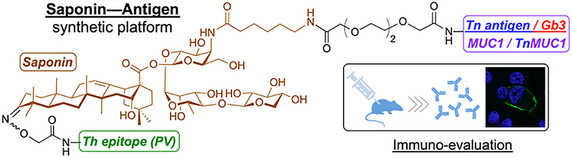
This study introduces innovative saponin-based self-adjuvanting vaccine constructs that combine tumor-associated carbohydrate and peptide epitopes, leveraging a streamlined, synthetically accessible minimal saponin platform derived from QS-21.
The uniqueness of this work lies in its modular, late-stage conjugation strategy that allows for the integration of diverse tumor antigens, such as Gb3, Tn antigen, and MUC1, alongside immunostimulatory epitopes, resulting in unimolecular constructs with intrinsic adjuvant activity. Unlike traditional adjuvants like QS-21, which face issues of scarcity, toxicity, and instability, these novel saponin derivatives are designed for greater stability, safety, and synthetic flexibility, making them promising candidates for cancer vaccines.
The authors conclude that their development of modular, saponin-based self-adjuvanting conjugates, derived from streamlined synthetic platforms such as QA and kEA, effectively elicited antigen-specific antibody responses in vivo without toxicity, demonstrating the potential of these constructs as vaccine candidates for cancer immunotherapy. These conjugates showed good safety profiles, structural versatility, and the capacity to recognize native tumor antigens, notably MUC1, on cancer cells. However, the study also acknowledges limitations, including moderate immunogenicity of the antigens tested and the need for further optimization to enhance immune responses, especially for weakly immunogenic tumor-associated carbohydrate antigens like Tn and Gb3. The authors suggest that future work should focus on refining the immunogenicity of these constructs, possibly by incorporating additional immunostimulatory elements or delivery strategies, and moving towards more comprehensive functional evaluations, including cell-mediated immunity and tumor challenge models.
Click here to access the full scientific paper.