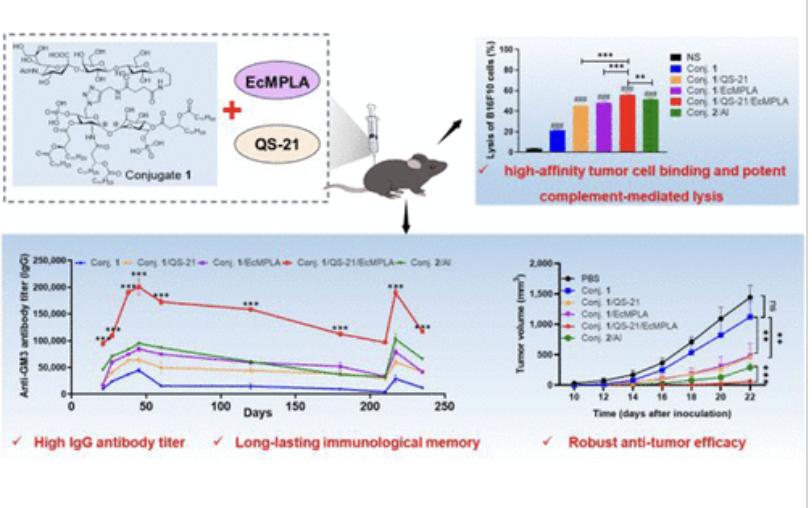


Liang, R., et al. Ganglioside GM3 and Lipid A Mimetic Conjugate Combined with EcMPLA and QS-21 as a Potential Vaccine Candidate for Cutaneous Melanoma Immunotherapy. J Med Chem, 2026 May 14, 69(9):11434-11447. PMID: 42077094
This paper is significant for its innovative use of the saponin adjuvant QS-21 in a self-adjuvanting vaccine targeting melanoma. The authors designed a GM3-based conjugate vaccine that incorporates lipid A mimetics as carriers, enabling strong immune responses without the need for traditional protein carriers. Notably, the study demonstrates a synergistic effect when QS-21, a purified saponin known for its potent immunostimulatory properties, is combined with EcMPLA, a TLR4 agonist. This combination markedly enhances both humoral and cellular immunity, leading to delayed tumor growth and improved survival in melanoma-bearing mice. The work is unique because it demonstrates that combining saponin-based adjuvants with pattern-recognition receptor agonists within a fully synthetic vaccine platform can overcome the poor immunogenicity of tumor-associated carbohydrate antigens such as GM3, paving the way for more effective cancer vaccines with potentially better safety and reproducibility than traditional protein-based conjugates.
Recent Posts