

TB vaccine development: monitoring international patent filings to anticipate access challenges
Pignataro, M.F., et al. TB vaccine development: monitoring international patent filings to anticipate access challenges. Front Public Health, 2026 Jan 16, 13:1726153. PMID: 41626371
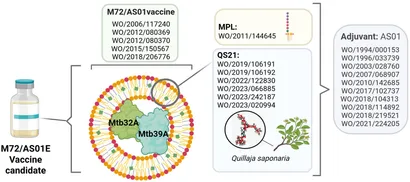
- This research emphasizes the urgent global health challenge posed by tuberculosis (TB), which causes significant morbidity and mortality each year. The development of these vaccines is crucial for controlling the epidemic, but access remains hindered by intellectual property (IP) barriers, which can limit manufacturing, supply, and affordability, especially in low- and middle-income countries with high TB burdens. Recognizing the importance of anticipating and addressing these barriers, the study aims to analyze the international patent landscape of two promising late-stage TB vaccine candidates (MTBVAC and M72/AS01E) and a key adjuvant component (QS- 21). The goal is to identify patent protection trends that could impact global access, supply, and manufacturing capacity, ultimately supporting strategies to ensure equitable and timely availability of TB vaccines worldwide.
- The study identified multiple patent filings related to the two TB vaccine candidates, with six PCT applications for MTBVAC, 22 for M72/AS01E, and 21 for the adjuvant QS-21. Several patents have been filed in high TB-burden countries like Brazil, India, and Chile, which possess manufacturing capacity or are key sources of adjuvant extraction, signaling strategic efforts to secure market control. The patent protection extends over several years, potentially creating monopolistic barriers that could hinder affordable manufacturing and supply in these countries. The findings suggest that such patent strategies may pose significant access challenges, especially if patents are granted in countries critical for vaccine production. Overall, these results highlight how patent landscapes can influence manufacturing, supply, prices, and ultimately, equitable access to TB vaccines globally.
- The paper also underscores the importance of global efforts, like the WHO’s initiatives and the proposed Pandemic Agreement, to facilitate equitable access by addressing IP barriers, promoting licensing agreements, and incentivizing voluntary technology transfer, thereby ensuring timely and affordable vaccine availability for populations most in need.
Click here to access the full scientific paper.
[arrow_forms id=’3298′]Recent Posts