

Enzymology and Structural Basis of Glycosyltransferases Involved in Saponin C28 Carboxylic Acid O‑d‑Fucosylation
Hudson, G.A., et al. Enzymology and Structural Basis of Glycosyltransferases Involved in Saponin C28 Carboxylic Acid OdFucosylation. JACS Au, 2025 Nov 24, 5(12):6011- 6024. PMID: 41450652
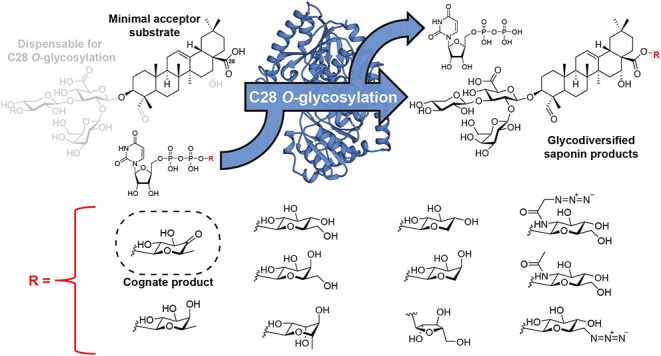
- This study centers on saponins, a diverse class of natural products with significant medicinal properties, including immune modulation, anti-inflammatory, and antimicrobial activities. Notably, QS-21, a prominent saponin adjuvant used in vaccines, relies on critical modifications such as C28-O-D-fucosylation that influence its bioactivity. Understanding the enzymology and structural basis of the glycosyltransferases involved in these modifications is essential for advancing the capacity to biosynthesize and engineer saponin analogs with enhanced or novel therapeutic properties. The primary goals of this research are to characterize two glycosyltransferases involved in C28-O-D-fucosylation—QsFucT and SvFucT—determine their substrate scope and enzymatic mechanisms, and determine their structures. These insights aim to facilitate the biosynthetic diversification of saponins, potentially leading to improved drug candidates and vaccine adjuvants.
- The main findings of this study reveal that both QsFucT and SvFucT function as UDP-4-keto-6-deoxy-D-glucosyltransferases with low-micromolar affinity for their triterpenoid acceptor substrates, displaying high permissiveness toward both the triterpene acceptors and UDP-sugar donors. Substrate scope analyses showed that these enzymes can act on simple oleanane aglycones and accept a broad range of UDP-sugar donors, which enhances their potential for glycoengineering. The structural characterization through crystallography uncovered the first structures of 4-keto-6-deoxy-D-glucosyltransferases within the GT1 family, providing insights into key conserved active site residues. These results suggest that QsFucT and SvFucT are versatile tools for saponin biosynthesis and diversification, offering opportunities to engineer novel saponin analogs with potentially improved pharmacological or physicochemical properties.
Click here to access the full scientific paper.
Recent Posts